How IELTS Band Scores Work, and the Path from 6.0 to 7.5
Your overall IELTS band is the average of your four section bands, rounded to the nearest half. That one rounding rule explains why a 6.0 and a 7.5 can be separated by a surprisingly small amount of focused work.
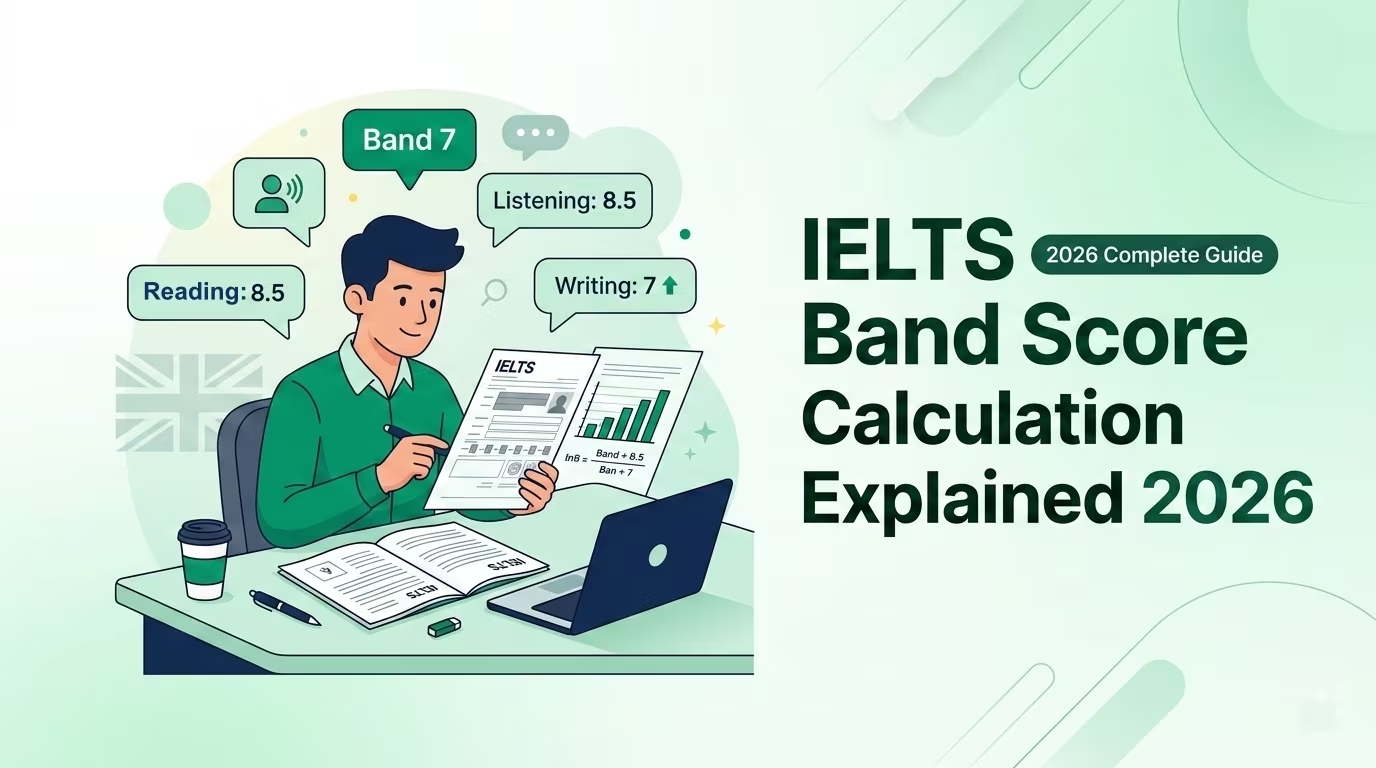
You get a band from 0 to 9 in each of Listening, Reading, Writing, and Speaking. The overall band is the mean of those four, rounded to the nearest whole or half band. The rounding is the part candidates miss. An average of 6.25 rounds up to 6.5, and 6.75 rounds up to 7.0, but 6.125 rounds down to 6.0. Half a mark on one section can therefore swing your overall band.
Worked example: Listening 7.0, Reading 6.5, Writing 6.0, Speaking 6.5 averages to 6.5. Lift only that Writing 6.0 to 7.0 and the average becomes 6.75, which rounds to 7.0. You did not improve everywhere; you fixed your lowest section. That is almost always the fastest route up. Try the figures yourself on our IELTS band score calculator.
What each band actually means
Bands describe how well you use English, not how many questions you answered. Knowing the descriptor for your target band tells you what an examiner is listening and reading for.
- Band 6 (Competent): generally effective English with some inaccuracies and misunderstandings; can use fairly complex language, especially in familiar situations.
- Band 7 (Good): operational command with occasional inaccuracies; handles complex language well and understands detailed reasoning.
- Band 8 (Very good): fully operational with only occasional unsystematic errors; handles complex, detailed argument well.
The jump from 6 to 7 is mostly about consistency and range: fewer repeated errors, and a wider stock of accurate vocabulary and sentence structures used naturally rather than forced.
Why so many candidates stall at 6.5
A 6.5 plateau is usually not a general English problem. It is one or two specific weaknesses dragging the average down while the other sections sit at 7.0. The two usual culprits are Writing and Speaking, because they reward extended, organised, accurate language rather than recognition.
In Writing, candidates lose marks by not answering the full task, by under-length responses, and by repeating the same simple structures. In Speaking, the gap is usually fluency and range: short answers, hesitation, and a narrow band of vocabulary. Both are trainable, but only if you know which one is actually costing you the half band, which is what a reviewed mock test tells you.
Section by section: how to gain the half band
Reading and Listening
These are the fastest to lift because the question types are predictable. The single highest-value skill is spotting paraphrase: the answer is rarely worded like the question. Drill True/False/Not Given and matching headings specifically, and review every wrong answer against the text.
Writing
Answer the whole task, hit the word count, and vary your sentence structures. Most band-6 essays repeat a single grammar pattern. Get one essay a day marked against the four criteria and fix your lowest one first.
Speaking
Extend every answer with a reason and an example, and record yourself to catch hesitation and repeated words. Fluency and a wider vocabulary range move this band more than perfect grammar does.
Target your lowest section
Because the overall is an average, the maths rewards lifting your weakest section, not polishing your strongest. Find it with a full mock, then spend most of your time there.
A realistic timeline
Moving from 6.0 to 7.5 is two full bands of average, but it is usually a half band on each of three sections, which is achievable in six to ten weeks of focused work for a candidate who already sits around 6.0. Start with a full mock to find your real section bands, spend most of your week on the lowest two, and re-test every week or two to confirm the gains are sticking. Trying to lift all four sections evenly is slower than fixing the two that are actually below target.
Conclusion
The band system rewards balance, so the route from 6.0 to 7.5 runs through your weakest section, not your strongest. Learn how the rounding works, find your lowest band with a real mock, and put your time where the maths pays off. That is a far faster path than studying everything equally.
Find your real section bands with a free IELTS mock test.
Take a free mock test