IELTS Practice Test Online Free with Score - and AI Feedback (2026)
The 60-second answer
- Reading and Listening on this site return a band score the moment you click Submit. No signup is needed to take Test 1.
- Writing and Speaking are graded by an AI engine against the four official IELTS criteria. You get an indicative band and the exact phrases that gained or lost marks.
- All four sections use the official raw-to-band conversion for 2026, so the band you see is the same band a real examiner would arrive at for the same raw mark.
- Start with a full mock test if you want one overall band, or with your weakest single section if you want a targeted score.
Most people Googling "IELTS practice test online free with score", "ielts sample test online free", or "ielts mock test with band score"are not really asking about test availability. There are dozens of free IELTS tests online. What they actually want to know is which free tests give you a real band score back with instant results, how that score is calculated, and whether it is close enough to a real IELTS result to be worth trusting.
This guide answers all three. We walk through every free test on the site, explain exactly how each one is graded (auto-grader for Reading and Listening, an AI rubric for Writing and Speaking), show the official conversion tables, and give you a two-week plan to put the scoring engine to work.
What an AI examiner changes about a free practice score
A free IELTS test is only worth taking if something credible marks it. Most "free test with score" pages stop at Reading and Listening, because those have an answer key a computer can check. Writing and Speaking - the two sections most candidates are actually worried about - get left as "practise and self-assess", which is no score at all. The difference here is an AI examiner trained on the four official IELTS band descriptors and calibrated against hundreds of essays and recordings scored by real examiners, so all four sections come back with a band and a reason.
| What you get back | Self-marked test | Free test, answer key only | This site (AI examiner) |
|---|---|---|---|
| Reading / Listening band | You estimate it | Official band | Official band + per-question breakdown |
| Writing band | No score | No score | AI band on all 4 criteria |
| Speaking band | No score | No score | AI band on all 4 criteria |
| Why your score is stuck | Guesswork | Not shown | The exact phrases that lost marks |
| Cost / signup | Free | Free | Free, no signup for Test 1 |
That last row is the one that matters. A bare number tells you where you are; the AI examiner tells you why, by pointing at the specific sentences and word choices that capped your band - which is the part you can actually act on before test day. The rest of this guide shows how each section is scored and how to turn that feedback into a higher band.
IELTS test online free with score - the three options
If you only have time to read one paragraph: there are exactly three flavours of free IELTS test online, and only one of them returns a real band score with instant results. A PDF download gives you the questions but no scoring. A handful of sample questions in a browser shows a raw count but no band. And an auto-graded full paper returns the band the moment you submit. This site falls into the third category for Reading and Listening, and adds AI-rubric grading for Writing and Speaking. The next section explains exactly how each flavour works so you know what to look for elsewhere too.
🎯What "with score" Actually Means
A free IELTS practice test can mean three very different things, and only one of them gives you a real band score back:
PDF download
A printable question paper with an answer key at the back. No score. You have to mark yourself and look up the conversion.
Sample questions
A handful of questions in a browser with the answers revealed at the end. Raw count only, not a band score, and rarely a full-length paper.
Auto-graded test
A full timed paper that returns a band score the moment you submit. This is what you actually want. Every Reading and Listening test on this site works this way.
The fourth flavour - and the rarest one online - is an AI-graded Writing or Speaking test. These cannot be auto-graded the way Reading and Listening can because the answer is open-ended, but they can be assessed by an AI rubric trained on the four official IELTS criteria. Done well, AI feedback lands within half a band of a human examiner on criteria like Lexical Resource and Grammatical Range, and within one band on Task Achievement. That is close enough to plan your study time against.
📚The Four Free IELTS Tests on This Site
| Section | Length | How it's scored | Score returned |
|---|---|---|---|
| Reading | 60 minutes / 40 questions | Auto-grader vs answer key | Band on submit |
| Listening | 30 minutes + 10 transfer / 40 Qs | Auto-grader vs answer key | Band on submit |
| Writing | 60 minutes / 2 tasks | AI feedback on 4 criteria | Band + criterion notes |
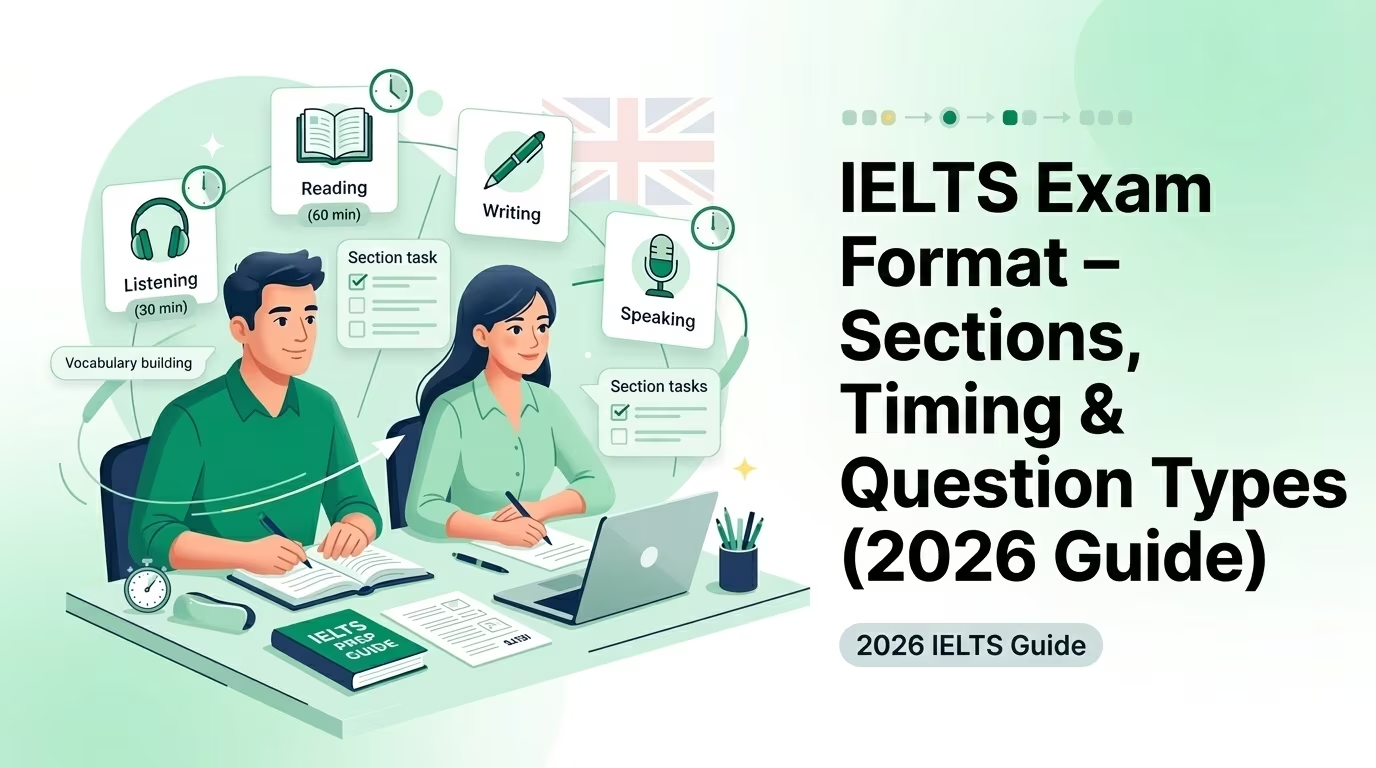
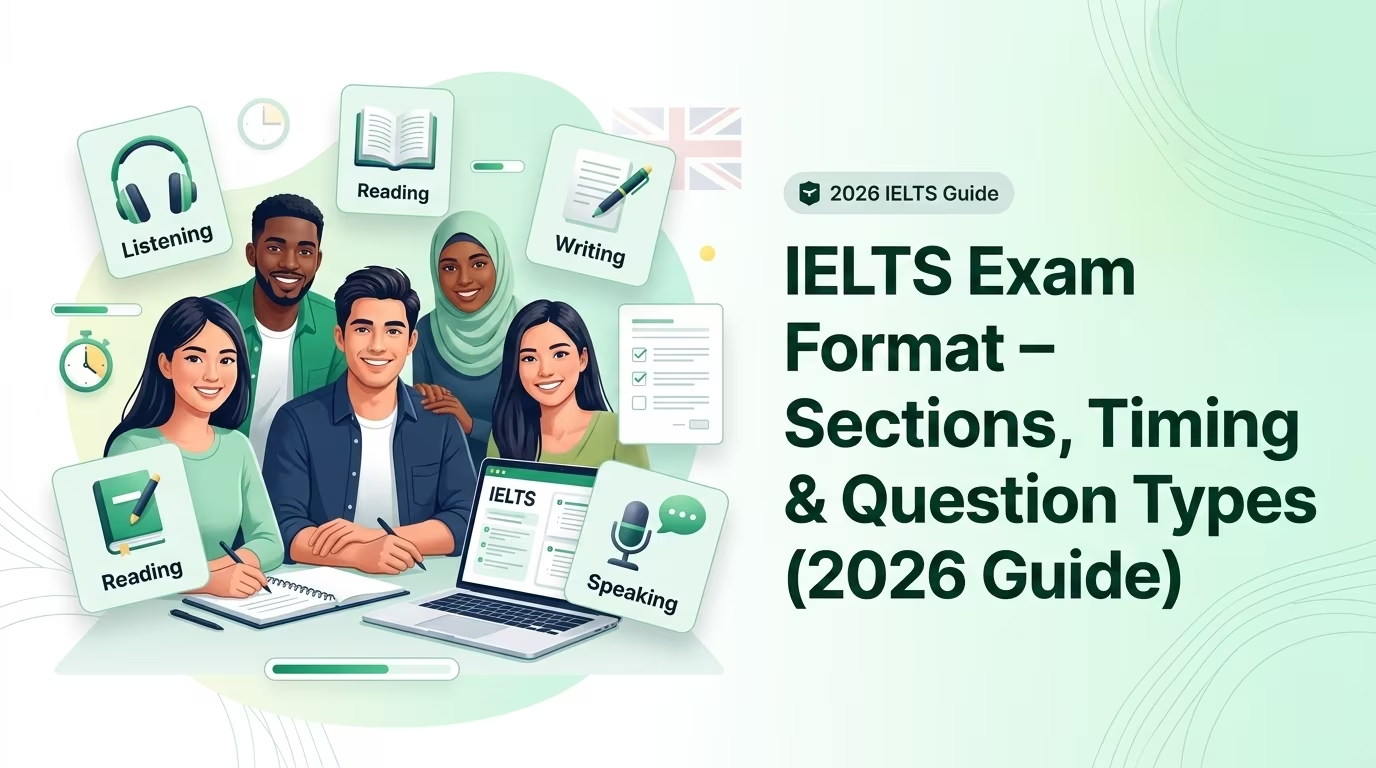
| Speaking | 11–14 minutes / 3 parts | AI feedback on 4 criteria | Band + criterion notes |
Test 1 in every section is free without signup. That is enough to get one indicative band per section and decide which one is weakest. The remaining tests sit behind a single inexpensive subscription - but the free Test 1 is the same length and difficulty as the paid tests, so the band you get from it is the band the engine would have given you on any test.
If you want a single overall bandthat combines all four sections - the way IELTS actually reports results - take the free full mock test. It runs Listening → Reading → Writing → Speaking back to back, scores each section independently, and applies the IELTS rounding rule to give you one overall band.
📖Reading: How the Auto-Grader Works
IELTS Academic Reading is the easiest section to grade automatically because every answer is a single word, number or letter from a closed answer key. The auto-grader on this site matches your typed answer against the official Cambridge answer set, tallies the raw mark out of 40, and runs it through the published Academic Reading conversion to give you a band.
Academic Reading raw-to-band (2026)
| Raw score (out of 40) | IELTS band | Typical visa / uni use |
|---|---|---|
| 39–40 | 9.0 | Native-level - Oxbridge, top US programmes |
| 37–38 | 8.5 | Medicine, law, top business schools |
| 35–36 | 8.0 | Russell Group, Group of Eight, Ivy League |
| 33–34 | 7.5 | Most postgraduate programmes |
| 30–32 | 7.0 | UK Tier 2 work visa, most postgraduate |
| 27–29 | 6.5 | Most UK / Australia undergraduate |
| 23–26 | 6.0 | Many Canada undergraduate, some PR pathways |
| 19–22 | 5.5 | Foundation / pathway programmes |
| 15–18 | 5.0 | Generally below entry threshold |
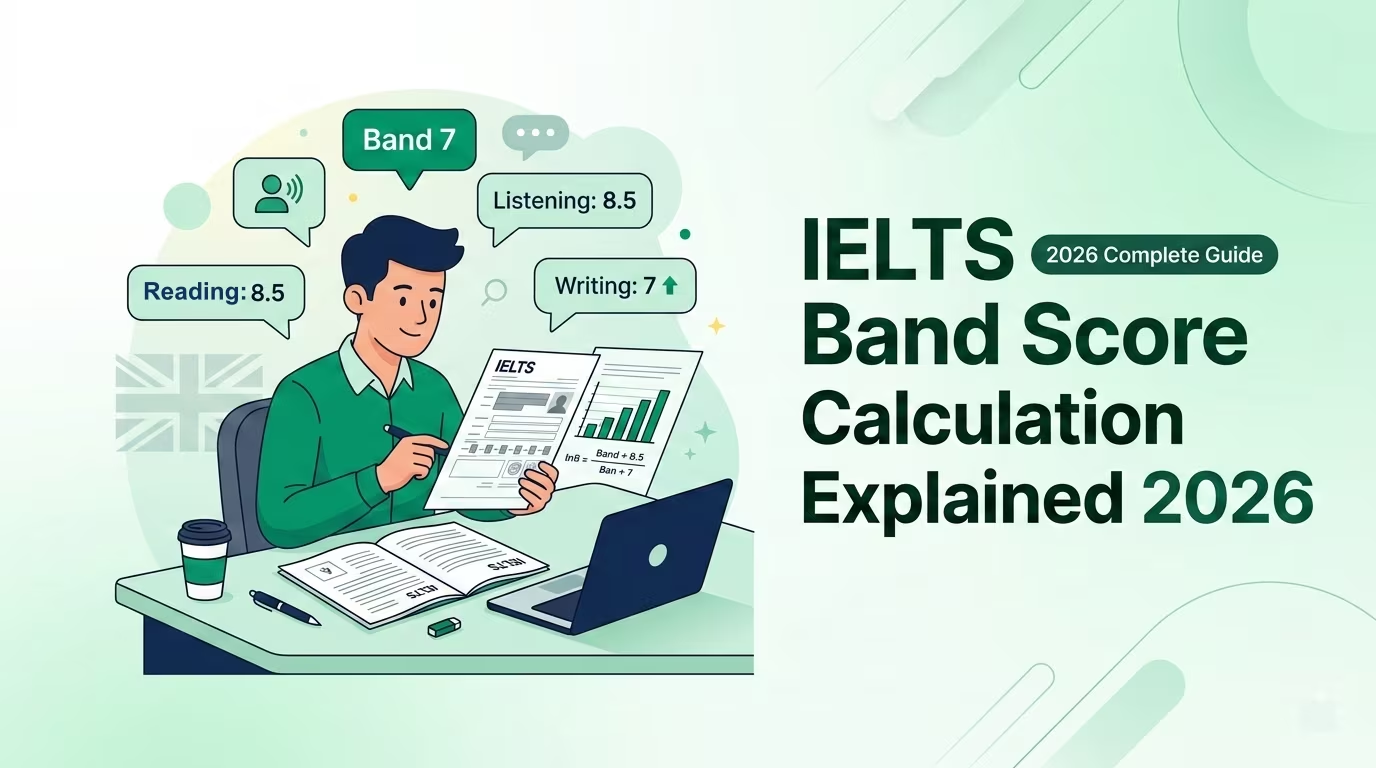
General Training Reading uses a stricter conversion because the texts are easier - 34/40 gives band 7 in GT versus 30/40 in Academic. The auto-grader on this site detects which paper you took and applies the right table automatically. For a deeper walkthrough of how the conversion is built, see our guide to IELTS band score calculation.
🎧Listening: How the Auto-Grader Works
Listening is graded the same way as Reading - 40 raw marks against a closed answer key, converted to a band - but with two extra things the auto-grader handles for you on this site:
- Spelling. Real IELTS Listening marks both British and American spellings as correct (colour / color, traveller / traveler). Our auto-grader applies the same dual-spelling rule the IELTS examiner does, so a US-trained candidate is not penalised for typing color instead of colour.
- Synonym answers. About 10% of Listening questions have more than one acceptable answer in the Cambridge key (e.g. twenty / 20). The grader accepts every variant the official key allows.
The Listening conversion is slightly more generous than Reading because the audio plays once and the cognitive load is higher:
| Raw score (out of 40) | IELTS band |
|---|---|
| 39–40 | 9.0 |
| 37–38 | 8.5 |
| 35–36 | 8.0 |
| 32–34 | 7.5 |
| 30–31 | 7.0 |
| 26–29 | 6.5 |
| 23–25 | 6.0 |
| 18–22 | 5.5 |
| 16–17 | 5.0 |
✍️Writing: AI Feedback on Four Criteria
IELTS Writing cannot be auto-graded the way Reading and Listening can - there is no single correct answer for a Task 2 essay. Instead the official examiner rubric scores each submission against four criteria, each worth a quarter of the total Writing band:
1. Task Achievement / Response
Does the essay actually answer the question? For Task 1, does it cover every part of the prompt and the main trends in the data?
2. Coherence and Cohesion
Is the essay logically organised, with one clear idea per paragraph and signposted with natural linking phrases?
3. Lexical Resource
Range and accuracy of vocabulary - including less common words used correctly, not just sprinkled in for show.
4. Grammatical Range and Accuracy
Variety of sentence structures, correct tense use, and how often grammar errors interfere with meaning.
The AI feedback engine on the Writing test page returns a band for each of the four criteria, the overall Writing band (the average rounded to the nearest half), and a list of the specific phrases that lifted or lowered each score. The point is not the band itself - it is the criterion-level breakdown, because that tells you which of the four things to actually work on next.
Most candidates plateau because they treat Writing as one skill instead of four. A band-6.0 essay with Task Achievement 7 / Coherence 6 / Lexical 5 / Grammar 6 is band-5 limited by Lexical Resource - and only deliberate vocabulary work will lift it. A general "write more essays" approach will not. AI feedback is what surfaces that.
🎙️Speaking: AI Feedback on Four Criteria
Speaking uses the same four-criterion framework as Writing, but with one criterion swapped to suit the medium:
1. Fluency and Coherence
Speech rate, pause length, and whether the response holds together logically. Replaces the Writing "Task Achievement" criterion.
2. Pronunciation
Word stress, sentence stress, and how easily a listener can understand without re-asking. Accent itself is not penalised.
3. Lexical Resource
Range and precision of vocabulary, including natural collocations and idiom use in Part 3.
4. Grammatical Range and Accuracy
Use of complex structures, tense control, and how often grammar slips interfere with listener comprehension.
The Speaking test page records your responses to all three parts - the personal interview, the long-turn cue card, and the discussion - and the AI engine transcribes and scores them against the four criteria above. You get the band per criterion plus the transcript with the specific sentences that pushed the score up or down.
🧭Which Section Should You Score First?
This is the single most common question, and the answer depends on what you are trying to find out:
Goal: "Am I close to my target overall band?"
Take the full mock. One sitting, four sections, overall band with the rounding rule applied.
Goal: "Which section is dragging me down?"
Take all four single-section tests over two days. Compare bands side by side. The lowest is where 80% of your study time should go.
Goal: "I already know my weak section"
Take that single section under timed conditions. If it is Writing or Speaking, the AI feedback will tell you which of the four criteria to focus on first.
One small caveat: do not take Writing and Speaking on the same day as a full mock. The cognitive fatigue at the end of a real IELTS exam day inflates errors in the open-ended sections by 0.5 to 1.0 bands. For a clean indicative score, do the open-ended sections fresh.
🧮Using the IELTS Band Score Calculator
Even if you have four section bands, working out the overall is not as simple as averaging them. IELTS applies a rounding rule:
- The average is rounded to the nearest half band.
- An average ending in .25 rounds up to the next half band.
- An average ending in .75 rounds up to the next whole band.
- Everything else rounds to the nearest 0.5.
This produces some non-obvious results. A candidate with 7.0 / 7.0 / 6.5 / 6.5 averages 6.75 and rounds up to band 7.0 overall. A candidate with 7.0 / 7.0 / 6.0 / 6.5 averages 6.625 and rounds to band 6.5 - half a band lower for one weak section.
The fastest way to handle this is the IELTS Band Score Calculator, which applies the official rounding rule for you. Enter the four section bands from your practice tests and read the overall - and more usefully, the calculator shows which single section, if lifted half a band, would push the overall up a notch. That tells you exactly where your next two weeks of study should go.
🎯How Accurate Is a Free Practice Score?
This is the question we get most often, and the honest answer is: it depends on the section.
| Section | Typical gap to real IELTS | Why |
|---|---|---|
| Reading | ±0.5 band | Closed answer key, identical conversion table |
| Listening | ±0.5 band | Closed answer key, identical conversion table |
| Writing | ±0.5 to ±1.0 band | AI is strong on Lexical and Grammar, less so on Task Achievement |
| Speaking | ±0.5 to ±1.0 band | Pronunciation scoring is harder for any rubric, human or AI |
For Reading and Listening, the score you get back is essentially the score a real examiner would give you on the same paper - the conversion is identical. The only variance is text difficulty across different Cambridge IELTS sets, which is why your first three Reading scores will often span half a band even if your skill has not changed.
For Writing and Speaking, treat the AI band as a reliable directional signal, not a final verdict. If the AI gives you 6.5 today and 7.0 next week, that lift is real. If you took the same essay to ten different human examiners, you would get a 0.5-band spread anyway - the AI sits inside that human spread on most criteria.
📅Two-Week Practice Plan
If you have a real test in two weeks and want to use the free practice tests on this site as your main feedback loop, run this plan:
Day 1: Diagnostic
Take the free full mock test. Note the four section bands and the overall.
Day 2: Identify weakest section
For Reading / Listening, look at the per-question breakdown - which question types lost most marks? For Writing / Speaking, which of the four criteria scored lowest?
Days 3–7: Drill the killer
Spend 70% of your daily practice on the single weakest section. Use the section-specific tips guide for technique fixes.
Day 8: Re-test the weak section
Take a fresh paper in the section you have been drilling. Confirm the lift before continuing - most candidates see 0.5–1.0 band improvement.
Days 9–12: Second-weakest section
Repeat the drill pattern on the next weakest section. Keep the first section warm with one paper every three days.
Day 13: Final full mock
Run a second full mock under exam-day conditions. Compare overall band to Day 1 and check the rounding behaviour in the Band Score Calculator.
Day 14 is rest. Counter-intuitively, candidates who rest the day before the real exam outperform those who cram by 0.3–0.5 bands on average - the same pattern professional musicians follow before a concert. The free practice tests have done their job by then; trust the score they have been giving you.
Between practice tests: the 50-word shortcut that lifts every section
Most candidates plateau between mock tests because they retake tests without changing their inputs. The fastest input to change is vocabulary: a core of high-frequency academic words appears in nearly every Reading passage, fits any Writing Task 2 essay, and upgrades Part 3 Speaking answers. Learn ten of these between each practice test and your next score reflects it.
| Word | Use it for | Instead of |
|---|---|---|
| significant | trends in Task 1, claims in Task 2 | big / important |
| fluctuate | describing unstable Task 1 data | go up and down |
| implement | policy essays (Task 2) | do / start |
| mitigate | problem-solution essays | reduce |
| substantial | quantities and evidence | a lot of |
| viable | evaluating solutions | possible |
| widespread | describing social trends | common |
| transform | technology and change topics | change a lot |
The full list lives in our free IELTS word list (50 essential academic words) with definitions, IELTS-style examples, and collocations. If Speaking is your weak section, pair it with the IELTS Speaking vocabulary page - 36 phrases for opinions, hedging, and storytelling that fit any Part 1-3 answer.
Conclusion
A free IELTS practice test is only useful if the score it gives you back is real. Reading and Listening on this site are graded against the official Cambridge answer key with the official 2026 raw-to-band conversion, so the number on your screen is the number a real examiner would arrive at.
Writing and Speaking can't be auto-graded the same way, but AI feedback on the four official criteria gives you a directional band and the specific phrases to fix - which is more actionable than a single bare number anyway. Start with the full mock, find your weakest section, and use the two-week plan above to close the gap.